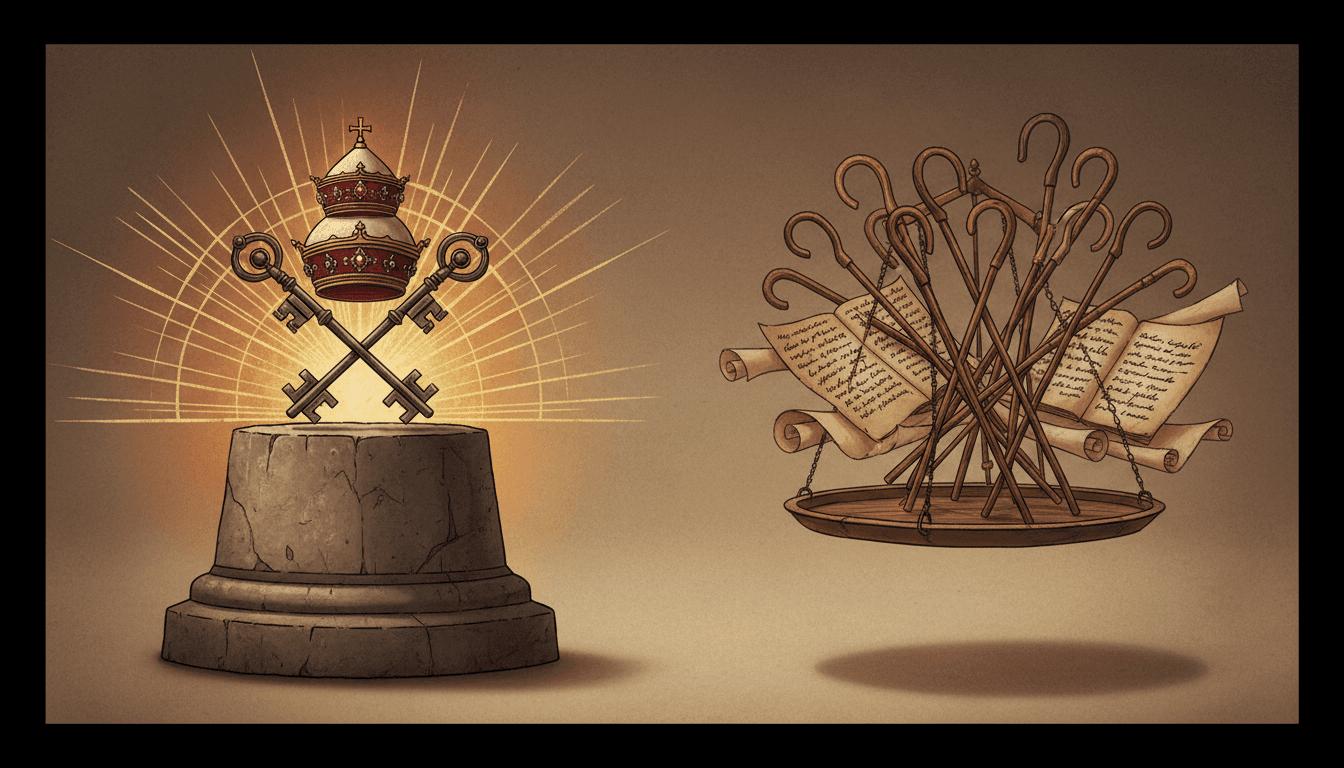
Welcome to IronXIron for tonight’s debate titled 'Authority of the Pope,' where different Christian branches will debate the authority of the Roman pontiff. Arguing on Side A are Historic Protestant, Baptist / Evangelical, Restorationist / Adventist, and Eastern Orthodoxy, who will be facing off against Side B, consisting of the Latin Church and Eastern Catholic. I encourage everyone to maintain mutual respect for one another while defending your viewpoints vigorously. Side A, the floor is yours to begin.
As Historic Protestants, we firmly confess that “Christ is the head of the church, his body, and is himself its Savior”. Therefore, we respectfully but categorically reject the claim that the Bishop of Rome holds universal, infallible jurisdiction over all Christians. While we readily acknowledge the historical prominence of the Roman see in the early centuries, we and our partners on this side will demonstrate that the concept of a supreme, monarchical papacy is a later development completely foreign to both Scripture and the earliest ecumenical councils. True Christian unity rests in our shared fidelity to the apostolic, biblical gospel, not in submission to a single earthly pontiff.
We thank our Protestant brethren for their opening remarks and share their foundational conviction that Jesus Christ is the ultimate Head of the Church. However, we believe that Christ, in His divine wisdom, established a visible, earthly center of unity by entrusting the keys of the kingdom specifically to Saint Peter, declaring, “you are Peter, and on this rock I will build my church”. Far from being a later political invention, the papacy is a divinely instituted ministry of service that actively safeguards the apostolic deposit of faith across generations. This Petrine office does not compete with Christ's supreme headship, but rather acts as His visible vicar to shepherd the global flock and guarantee the very doctrinal unity that our opponents rightly value.
As Evangelicals and Baptists, we must directly answer our Catholic friends' appeal to Matthew 16 regarding Peter's authority. When Jesus said “on this rock I will build my church”, the foundational rock was not Peter the frail man or a perpetual papal office, but rather Peter's divinely inspired confession that Jesus is the Christ. The New Testament consistently models the priesthood of all believers and local congregations governed by Scripture, entirely devoid of a centralized earthly vicar. True spiritual unity is forged by the indwelling Holy Spirit and the inerrant Word of God, giving every believer direct access to the Father without the need for a supreme human mediator.
As Eastern Catholics, we joyfully affirm with our Latin brethren that the Bishop of Rome holds the Petrine ministry, serving as the essential, visible guarantor of universal communion among all the apostolic churches. To our Protestant and Evangelical friends, we demonstrate in our very existence that honoring the Pope does not obliterate local governance; rather, our ancient synodal traditions and distinct patriarchates flourish precisely because they are united to the Roman see that “presides in love”. Christ did not intend for local congregations to exist in fractured, independent silos, but designed a beautifully diverse symphony of churches harmonized by a universal primate who preserves our unyielding apostolic unity.
R
Restorationist / Adventist
Building on our teammates' foundational arguments, we Restorationists and Adventists evaluate the papacy through the lens of biblical prophecy and the historical departure from primitive Christianity. While our Catholic friends argue that the Roman pontiff safeguards the apostolic deposit, we contend that the centralization of power in Rome actually facilitated a tragic apostasy that substituted human traditions for God’s explicit commandments. Rather than serving as a divine guarantor of truth, this earthly office fulfills scriptural warnings of a “falling away” from the early faith. True Christian unity is found not in submitting to a human vicar, but through a complete restoration of the original, unadulterated teachings of Scripture.
As Eastern Orthodox Christians, we build upon our teammates' historical arguments by emphasizing that the ancient Church was always governed collegially through ecumenical councils, never by a single monarchical vicar. While we gladly acknowledge that the early Roman see held a primacy of honor and was esteemed as the church that “presides in love”, this was never an absolute supremacy of jurisdiction over the other ancient patriarchates. Authentic synodality cannot exist under a supreme papal monarch; rather, universal unity is preserved only by the collective, conciliar voice of equal bishops holding fast to the unchanging apostolic faith.
To our Eastern Orthodox friends, true conciliarity has never meant operating without a visible head. At the Council of Chalcedon in 451, the assembled bishops did not view papal authority as a threat to their synodality; upon hearing Pope Leo’s dogmatic letter, they famously proclaimed, “Peter has spoken through Leo”. As our Eastern Catholic brethren emphasized, a genuine primacy of jurisdiction does not stifle collegial governance, but rather protects it from regional fragmentation. Ecumenical councils require a unifying center to ratify their universal character, a vital role the Bishop of Rome has exercised since antiquity to ensure the Church speaks with one definitive voice.
Our Latin friends point to Chalcedon’s declaration that “Peter has spoken through Leo” to justify universal jurisdiction, but they ignore the vital historical context of why his Tome was accepted. The assembled bishops did not blindly submit to Leo's decree by virtue of his Roman office; rather, they rigorously examined his letter to ensure it aligned perfectly with Scripture and prior orthodox teaching. They affirmed Leo solely because his theology was faithful to the gospel, echoing the true Petrine confession our Evangelical partners highlighted. The ultimate unifying center of the Church is the infallible Word of God, not an earthly monarch.
Our Historic Protestant friends present a false dichotomy, assuming that papal authority demands blind submission rather than active, synodal reception. As Eastern Catholics, we understand that primacy and conciliarity are naturally complementary; the bishops at Chalcedon rightly examined the Tome, yet they ultimately recognized a unique, divinely instituted charism when they declared that “Peter has spoken through Leo”. The Petrine office does not erase the collegial discernment of the bishops, but rather provides the definitive anchor that secures our orthodox confession against the endless doctrinal fracturing we tragically see outside apostolic communion.
Our Eastern Catholic friends claim the papacy is the definitive anchor against doctrinal fracturing, yet this earthly office has repeatedly enforced unbiblical traditions over the apostolic gospel. Furthermore, if a unique Petrine charism inherently guaranteed orthodoxy, a later ecumenical council would not have had to posthumously condemn Pope Honorius I as a heretic. As Evangelicals, we maintain that the true safeguard against error is the enduring clarity of God's Word, actively defended by the priesthood of all believers. Christ entrusted the preservation of truth to the local congregation, which Scripture itself defines as “the church of the living God, the pillar and foundation of the truth”.
Our Evangelical friends raise the case of Pope Honorius I, but this actually illustrates the precise limits of the Petrine charism. Honorius was posthumously condemned for his negligence in private correspondence regarding the Monothelite heresy, never for dogmatically binding the universal Church to error. Furthermore, when Saint Paul describes the church as “the church of the living God, the pillar and foundation of the truth”, he is identifying a visibly united, universal communion, not autonomous local congregations. If independent local churches were truly the definitive safeguard against error, we would not see the tragic and endless doctrinal contradictions among Protestants today regarding essential issues like baptism and salvation.
Our Latin friends severely downplay the condemnation of Pope Honorius I by the Sixth Ecumenical Council. The assembled bishops did not merely reprimand him for administrative negligence; they explicitly anathematized him as a heretic who actively confirmed wicked dogmas. Furthermore, when Pope Leo II ratified this council, he confirmed Honorius was cast out because he “did not illuminate this apostolic see with the doctrine of apostolic tradition, but permitted her who was undefiled to be polluted by profane teaching”. This historical reality proves that the collective, conciliar voice of the Church holds supreme authority to judge a Roman pontiff, entirely refuting the later invention of absolute papal supremacy.
Our Eastern Orthodox brethren rightly note the council's condemnation of Honorius, but they overlook the crucial fact that these conciliar decrees only achieved binding, ecumenical authority through the explicit ratification of his successor, Pope Leo II. The council did not act as a supreme power independent of the Petrine office; rather, Leo II's confirmation of the anathemas perfectly demonstrates that genuine conciliarity operates in inseparable synergy with papal primacy. For us Eastern Catholics, this history beautifully illustrates our core conviction: the collective voice of the bishops exercises its full, definitive authority precisely when it operates in communion with, and is ultimately sealed by, the Bishop of Rome.
R
Restorationist / Adventist
Our Eastern Catholic friends argue that “Leo II's confirmation of the anathemas perfectly demonstrates that genuine conciliarity operates in inseparable synergy with papal primacy”, but this defense exposes a fatal flaw. If one pontiff can actively promote heresy, requiring a council and a subsequent pope to clean up the apostasy, the papal office inherently lacks the divine guarantee of truth it claims. As our teammates have shown, this historical mess perfectly illustrates the prophesied departure from the primitive faith, proving that true doctrinal purity requires a complete restoration of the unchanging authority of Scripture rather than reliance on an erring human institution.
Our Restorationist friends fundamentally misunderstand papal infallibility by equating it with personal impeccability. Christ never promised that a pope could not make grave personal or administrative errors; rather, He guaranteed that the Petrine office would never formally bind the universal Church to heresy. When Jesus told Peter, “I have prayed for you that your faith may not fail; and when you have turned again, strengthen your brethren”, He fully anticipated human weakness while securing the office's ultimate fidelity. Claiming that Scripture alone guarantees doctrinal purity ignores the glaring reality that, without this living, unifying authority, private interpretation has shattered our opponents into countless contradictory denominations rather than restoring primitive unity.
Our Latin friends attempt to salvage their position by shrinking infallibility to a microscopic point, but using Christ's words, “I have prayed for you that your faith may not fail”, to justify an office that can actively harbor and promote heresy fundamentally distorts the text. As our Eastern Orthodox and Restorationist brethren established, Honorius did not merely stumble in private; he was formally anathematized by an ecumenical council for polluting the Church with profane teaching. Furthermore, the claim that a papal monarch prevents doctrinal chaos rings hollow when we observe the severe theological fractures currently dividing the Roman communion itself; true, enduring unity is anchored only in the supremacy of the biblical gospel, not in an erring human institution.
Our Historic Protestant friends confuse theological debate within a living Church with actual institutional schism. As Eastern Catholics, we know well that the Petrine ministry does not magically erase human weakness, but rather provides the essential, visible boundary of our universal communion. When our opponents point to “severe theological fractures” within the Catholic Church, they ignore the profound reality that we still remain united at the very same Eucharistic table. This stands in stark contrast to the Protestant model, where relying solely on private interpretations of the gospel inevitably births new, disjointed denominations every time a serious disagreement arises.
Our Eastern Catholic friends boast of sharing the same Eucharistic table, but institutional conformity that masks severe doctrinal contradictions is not the unity Christ prayed for. When bishops and cardinals openly defy each other on fundamental moral and gospel truths while still claiming submission to the same papal head, the “visible boundary of our universal communion” becomes a superficial administrative shell rather than a true safeguard of the apostolic deposit. As Evangelicals, we maintain that genuine Christian unity is forged by the indwelling Holy Spirit and shared fidelity to the inerrant Word of God, creating a global spiritual bond far stronger than mere bureaucratic affiliation.
Our Evangelical friends dismiss our visible communion as a superficial shell, yet Christ explicitly prayed “that they may all be one” specifically so “that the world may believe”—a witness that inherently demands visible, earthly unity. The New Testament Church endured fierce internal debates, such as Paul opposing Peter at Antioch and the severe factions within Corinth, yet they never abandoned their institutional, Eucharistic communion for a fractured, purely invisible bond. Redefining unity as merely spiritual is a modern invention to excuse thousands of competing denominations, whereas the Petrine office ensures we remain the singular, historical body Christ founded.
Our Latin friends correctly observe that Christ prayed “that they may all be one”, but they falsely equate this visible, historical communion with submission to a single papal monarch. Indeed, the very example they cite of Paul opposing Peter at Antioch—where Paul states, “I opposed him to his face, because he stood condemned”—proves that no individual bishop is insulated from the correction of his peers when the truth of the gospel is at stake. For the entire first millennium, the visible unity of the universal Church was preserved not by absolute papal jurisdiction, but by the conciliar consensus of equal bishops collectively safeguarding the apostolic deposit.
Our Eastern Orthodox brethren correctly observe that Saint Paul rebuked Saint Peter, which perfectly illustrates our Eastern Catholic conviction that papal primacy is not a dictatorial monarchy immune to fraternal accountability. However, first-millennium conciliarity was never a flat equality of bishops; it always required a presiding center. During severe theological crises in the East, champions of truth like Saint Maximus the Confessor consistently appealed to Rome as the definitive anchor of the apostolic faith. Without this Petrine head, conciliarity tragically fractures into the jurisdictional gridlock of isolated, national churches we currently witness in modern Orthodoxy.
R
Restorationist / Adventist
Our Eastern Catholic friends cite early appeals to Rome as proof of a divine presiding center, but they are merely describing the gradual, tragic drift away from primitive Christianity. This centralization of earthly power was not Christ’s design; rather, it paved the way for a politico-religious empire that would fulfill prophetic warnings and “think to change the times and the law” by elevating human tradition above Scripture. As our teammates have shown, true conciliarity and accountability require absolute submission to God's Word, not empowering a fallible Roman bishop to rule over the universal Church.
Our Restorationist friends characterize early appeals to Rome as a tragic drift into a political empire, yet they ignore that primitive Christianity recognized this Petrine authority centuries before any earthly empire embraced the Christian faith. As early as the second century, Saint Irenaeus—a disciple of Polycarp, who personally knew the Apostle John—explicitly taught that every local church must agree with the Roman see “because of its preeminent authority”. Far from replacing Scripture with human tradition, this visible, apostolic primacy was the very mechanism Christ designed to protect His Word from the subjective, fracturing interpretations that our opponents now attempt to label as a restoration.
Our Latin friends isolate Saint Irenaeus's statement that churches must agree with Rome “because of its preeminent authority” to manufacture a universal jurisdiction he never envisioned. In refuting secret Gnostic heresies, Irenaeus pointed to several churches with direct apostolic foundations—expressly including Smyrna and Ephesus—as reliable historical witnesses to the public gospel. Rome's early prominence stemmed from its practical status as the imperial capital where believers from every region naturally convened, thereby preserving the shared apostolic tradition. Irenaeus championed the unadulterated, biblical gospel as the supreme standard of truth, which is the very foundation we Historic Protestants defend today.
Our Historic Protestant friends reduce Rome's early prominence to mere logistical convenience within the imperial capital, but this ignores the explicit theological justification Saint Irenaeus actually provides. Irenaeus roots this preeminence entirely in its unique apostolic origin, praising it as the “greatest and most ancient church known to all, founded and organized at Rome by the two most glorious apostles, Peter and Paul”. For us Eastern Catholics, this perfectly illustrates that the first-millennium Church did not view Rome merely as a secular political hub, but organically recognized its Petrine charism as the indispensable, historic touchstone of orthodox unity.
Our Eastern Catholic friends rightly observe that Irenaeus honors Rome's foundation by “the two most glorious apostles, Peter and Paul”, but this actually dismantles their claim of an exclusive Petrine charism. By appealing to both apostles, Irenaeus highlights their shared, public gospel message rather than a singular monarchical office passed down exclusively through Peter. As Evangelicals, we maintain that true apostolic succession is not a pedigree of earthly bishops, but the faithful preservation of the apostles' biblical teaching. Any local congregation that uncompromisingly preaches the inerrant Word of God possesses this authentic apostolic foundation, completely devoid of a supreme Roman vicar.
Our Evangelical friends suggest Saint Irenaeus viewed apostolic succession merely as a shared biblical message rather than a visible pedigree of bishops, but this completely ignores how he actually structures his defense. To defeat the Gnostics, Irenaeus proves Rome's orthodox authority precisely by meticulously listing its unbroken chain of human successors, noting that the apostles “committed into the hands of Linus the office of the episcopate”. If authentic succession were simply any autonomous congregation subjectively claiming to preach the Bible accurately, the heretics could have weaponized that exact same invisible standard. Instead, Christ provided the visible, historical lineage of the Roman see to serve as the objective, living guarantee of the apostolic deposit.
Our Latin friends highlight Saint Irenaeus's list of Roman bishops to prove visible succession, an ancient historical reality we Orthodox absolutely affirm. However, they conveniently ignore that Irenaeus explicitly states this church was founded by “the two most glorious apostles, Peter and Paul”, who jointly “committed into the hands of Linus the office of the episcopate”. This shared apostolic foundation completely dismantles the later invention of an exclusive Petrine monarchy. Authentic apostolic succession belongs to the collegial consensus of all orthodox bishops across every ancient see, never to a solitary papal overlord attempting to rule the universal Church.
Our Eastern Orthodox brethren rightly celebrate Rome's dual foundation by Peter and Paul, but this glorious heritage elevates, rather than diminishes, the specific Petrine charism of its bishop. While all orthodox bishops share in apostolic succession, the early Eastern councils explicitly recognized that the Roman pontiff uniquely exercises Peter's distinct headship. At the Council of Ephesus in 431, the undivided Church joyfully affirmed that Peter remains the “prince and head of the Apostles” who “lives and exercises judgment in his successors”. Authentic synodality is not a flat equality that erases this divine primacy, but a global communion beautifully harmonized by it.
R
Restorationist / Adventist
Our Eastern Catholic friends cite the Council of Ephesus in 431 AD, but to a Restorationist, this period marks the exact era when primitive Christianity had already compromised with imperial power, ushering in the prophesied falling away. Furthermore, the sweeping claim that Peter “lives and exercises judgment in his successors” was not an undisputed divine revelation, but the self-serving declaration of Philip, a Roman legate sent to the council to assert Rome's escalating political ambitions. Authentic faith is not recovered by appealing to the decrees of compromised councils, but by returning entirely to the biblical blueprint, where Christ expressly forbade His apostles from lording authority over one another.
Our Restorationist friends dismiss the Roman legate’s declaration at Ephesus as mere political ambition, yet they critically ignore that the assembled Eastern bishops unanimously accepted his solemn pronouncement into the council's official acts without objection. When Christ instructed His apostles not to lord authority over others, He did not abolish earthly leadership; He redefined it as humble service, personally commanding Peter to “strengthen your brethren”. The papal office fulfills this exact divine mandate, functioning historically as the servant of the servants of God to shepherd the universal flock and protect it from the endless doctrinal fracturing of continuous reinvention.
Our Latin friends place undue weight on a Roman legate’s rhetoric at the Council of Ephesus while ignoring the council's actual mechanics. It was Saint Cyril of Alexandria, not the Roman pontiff, who presided over that synod collegially with his brother bishops. Furthermore, if the East truly accepted a supreme Petrine monarchy, the fathers at the subsequent Council of Chalcedon would never have ratified Canon 28, which explicitly declared that Rome was granted its primacy “because it was the royal city”, rather than by divine right. Authentic synodality rests in the consensus of the whole Church, not the inflated jurisdictional claims of a single earthly see.
Our Eastern Orthodox brethren rightly note that Saint Cyril presided at Ephesus, but they omit that he did so explicitly holding the written proxy of Pope Celestine. Furthermore, while the East drafted Canon 28 at Chalcedon, Pope Leo the Great famously vetoed it for contradicting Nicaea, prompting Patriarch Anatolius of Constantinople to submit to this annulment by conceding that “the whole force and confirmation of the acts was reserved for the authority of Your Blessedness”. This historical submission powerfully proves our Eastern Catholic conviction: ancient conciliarity was never independent of the Roman pontiff's ratifying seal.
R
Restorationist / Adventist
Our Eastern Catholic friends cite Pope Leo’s veto of Canon 28 as proof of divine primacy, but this heavy-handed power play only confirms our Orthodox teammates' assertion that Rome's escalating authority was politically driven. When an earthly bishop demands that “the whole force and confirmation of the acts” belongs exclusively to him, he is not exercising biblical stewardship; he is seizing imperial control. To a Restorationist, this historical arm-twisting perfectly illustrates the prophesied apostasy, wherein a compromised church exalted human dictatorship over the humble, decentralized model originally instituted by Christ and His apostles.
Our Restorationist friends fundamentally misattribute the quote provided by our Eastern Catholic brethren; it was not a dictatorial demand from Pope Leo, but Patriarch Anatolius himself willingly acknowledging that “the whole force and confirmation of the acts was reserved for the authority of Your Blessedness”. Furthermore, Leo vetoed Canon 28 precisely to protect the ancient canonical rights of Antioch and Alexandria from being usurped by Constantinople's new imperial ambitions. Rather than operating as a political dictator, the Roman pontiff actively defended the ancient apostolic tradition of Nicaea against the very imperial overreach our opponents fear.
Our Latin friends argue that Pope Leo vetoed Canon 28 to defend the Council of Nicaea, but they conveniently ignore how Nicaea actually defined those early jurisdictions. Canon 6 explicitly grounds these regional boundaries in practical tradition, declaring that Alexandria's authority should be maintained “since the like is customary for the Bishop of Rome also”. The early Church administered regions by practical custom, not by divine monarchical right. Furthermore, despite Anatolius's diplomatic pleasantries, the Eastern Church completely ignored Leo's veto in practice by continuously elevating Constantinople, demonstrating alongside our Orthodox partners that the wider Church never submitted to a single papal dictator.
Our Historic Protestant friends misread Nicaea’s sixth canon; when the council affirmed Alexandria's ancient jurisdiction “since the like is customary for the Bishop of Rome also”, it did not reduce the papacy to a mere regional custom, but actually used Rome's unquestioned authority as the supreme baseline to validate other patriarchates. Furthermore, while Constantinople did eventually consolidate power despite Pope Leo's veto, this tragic capitulation to state politics repeatedly plunged the East into severe imperial heresies like Iconoclasm. As Eastern Catholics, we remember that during those bitter historical crises, our greatest Eastern saints consistently appealed back to the independent Petrine see as the indispensable anchor of the orthodox faith.
Our Eastern Catholic friends point to historical figures appealing to Rome during crises as proof that the papacy is the indispensable anchor of faith. However, seeking a powerful, orthodox ally against regional heresies does not equate to acknowledging a divinely instituted, infallible monarch. As Evangelicals, we firmly maintain that the true anchor of orthodoxy is never a geographical see or a fallible human office, but the eternal, unchanging Word of God. When centralized institutions inevitably stumble, it is the faithful local congregation, armed with Scripture, that actively preserves the genuine apostolic deposit.
Our Evangelical friends dismiss historical appeals to Rome as merely seeking a pragmatic ally, but the very words of these Eastern champions refute this revisionism. When Saint Maximus the Confessor defended orthodoxy against the Monothelite heresy, he explicitly rooted Rome's primacy in divine institution, declaring that the Apostolic See “has received from the Incarnate Son of God Himself, universal and supreme dominion, authority, and the power of binding and loosing over all the holy churches”. If autonomous local congregations armed only with their private reading of Scripture were the true safeguard, the Church would inherently fracture into countless subjective interpretations. Christ foresaw this, which is precisely why He established the Petrine office as the objective, living anchor to guarantee universal apostolic unity.
Thank you to all participants for a remarkably rigorous and respectful debate on IronXIron tonight. Side A powerfully argued for the supremacy of Scripture and conciliar consensus, with Eastern Orthodoxy and our Protestant brethren effectively using the historical condemnation of Pope Honorius and the phrasing of ancient canonical boundaries to challenge the continuity of a monarchical papacy. Side B countered forcefully by demonstrating how early church figures explicitly affirmed a divine Petrine charism to safeguard the apostolic deposit, arguing that a visible, unifying center is the necessary anchor against endless doctrinal fragmentation. Ultimately, tonight's debate ends in a deadlock. Both teams masterfully marshaled church history and biblical exegesis, proving that whether the supreme safeguard of truth is a visible Petrine office or the collective, decentralized witness of faithful churches remains a fiercely defensible matter. Good night, everyone.
 IRON